Bridging the divide: What will stop gentrification hurting South Auckland?

Thousands of new houses are set to be built in South Auckland over the next 10 years, but the gentrifying impact of this influx of new residents is raising concerns in the existing communities. As Liz Filimoemaka crossed the bridge between her predominantly state housing community and a newly established development in Wiri, she noticed … Read more

How Ardern, Collins and Gower rinsed away the Trump bile

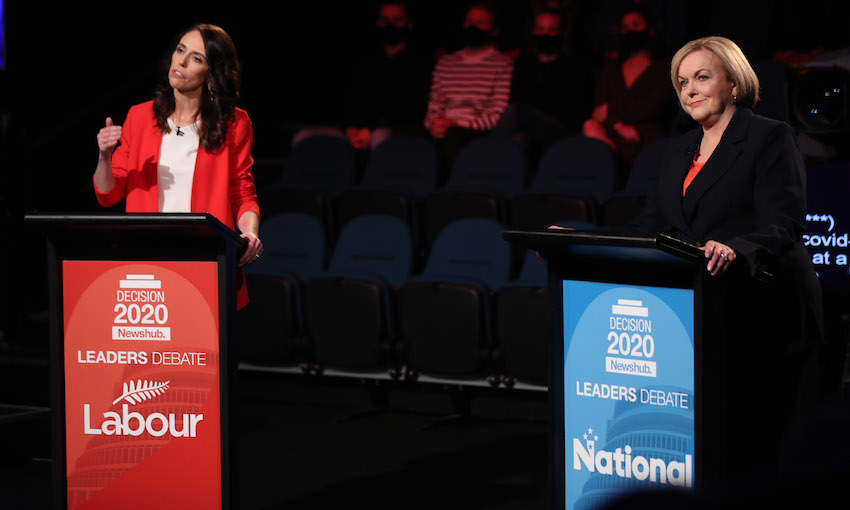
Toby Manhire watched the second leaders’ debate among a crowd of undecided voters at Q Theatre. Maybe the afternoon meal of pulled teeth and gravel soup in the presidential debate emphasised it but, shit, that was a good debate. Whether it was a motivational speech or a few Red Bulls, Jacinda Ardern had a different … Read more

Leaders’ debate #2, election 2020: The verdicts

Who came out on top in the second leaders’ debate? Here are our debate watchers’ verdicts.  Duncan Greive: Collins finds her voice The second debate was superior in every way. The staging and lighting more dramatic, the question lines more urgent, the leaders more determined to clearly demark the territory between them. Within the first … Read more

Election Live, September 30: Ardern and Collins go head to head in second leaders’ debate

Welcome to The Spinoff’s Election Live for September 30, bringing you the latest on election 2020 and other NZ news. The essential campaign dates are here. For all you need to know about the cannabis referendum click here. For the assisted dying referendum click here. Explore the parties’ pledges at Policy. I’m on stewart@thespinoff.co.nz 9.10pm: That’s a … Read more

Trump vs Biden: The worst moments of the worst presidential debate of all time

It was all awful, but these were the most awful bits. Well, that was … something. All those who made it through the first Donald Trump/Joe Biden debate are now bonded by the horror of the experience, one which veteran commentators are variously calling “a disgrace”, “a train wreck” and “the worst debate I have … Read more

For L.A.B, the air is clear

They’ve been on the album charts for two years, they’ve had a number one single, and now they’re one of our biggest live draws too. So what comes next for L.A.B? Even in a year marked by disruption, L.A.B’s 2020 has been more eventful than most. Forced to postpone local shows and an Australian tour … Read more

How Wellington’s food community is bouncing back

After a year of uncertainty and disruption, the capital’s hospitality industry says Visa Wellington On a Plate will bring a much-needed boost – to spirits as well as business. For two-and-a-half weeks in August 2018, Wellingtonians Casey and Blair Wilson worked 20-hour days, taking turns to sleep in four-hour shifts. “We had no understanding of how … Read more

One day you will die, and you will have to tell Jesus Christ the things you’ve said about Judith Collins

Some people were shocked when Judith Collins told Nicky Hager he would have to account for his mean words about her when he ‘meets his maker’. The National leader was simply articulating an orthodox theological position, writes Hayden Donnell. Working at The Spinoff has its challenges. Editors keep posting unflattering pictures of me above my … Read more

100 Year Forecast: Where will New Zealand be most at risk from flooding?

Watch all five episodes of 100 Year Forecast on our special interactive website HERE. Aotearoa is a steep and rugged country. Our settlements are concentrated in pockets of fertile floodplains, around river mouths or along coastlines. During the last few decades, these places have experienced increased river and coastal flooding. As sea levels rise and … Read more

‘I’m part of the movement’: Finding place and connection through te reo Māori

Two years ago, Haider Khan started his te reo Māori journey. Since then, he says, a new world has opened up for him, and he’s uncovered connections that he’d never noticed before.  Haider Khan was inspired to take up te reo Māori at precisely the wrong time. After hearing a coworker at Spark delivering a … Read more

Why overseas meddling in the New Zealand election is good for everybody

With overseas voting in the general election opening today, a new campaign is urging the estimated one million New Zealanders abroad to exercise their democratic right. Don’t be alarmed when you see Viktor inciting eligible offshore New Zealanders to meddle, meddle, meddle as the nonpartisan initiative Every Kiwi Vote Counts launches today. The foil is … Read more

The Bulletin: Peters draws distinction between NZ First party and NZ First Foundation

Good morning and welcome to The Bulletin. In today’s edition: SFO files charges against two people in connection with NZ First Foundation, tourism industry holding out Christmas bubble hope, and Advance NZ go to court over debate exclusion. Just days before voting starts, we got an update yesterday on the Serious Fraud Office investigation into the … Read more

What property managers think of the cold, damp homes they look after

The quest for healthy rentals is often portrayed as a battle between sickly tenants and their merciless landlords. But where do the middlemen (and women) sit on the issue? It’s hard not to view New Zealand’s quest for liveable rental housing as an intense, politically-charged feud: on one side are the renters, the NGOs and … Read more

Misinformation isn’t new, so how can we control it?

In episode three of Conversations that Count – Ngā Kōrero Whai Take, we take a very timely deep-dive into the complicated world of online misinformation and disinformation.

In some ways, the large-scale wave of disinformation which has swamped New Zealand’s streets and social feeds throughout 2020 comes without surprise. Faced with a catastrophic global pandemic and a commensurately wide-ranging response from our central government, it’s to a degree understandable that members of the public – particularly those predisposed to distrust either the parties in power or the system as a whole – would seek alternative explanations for the realities we’re facing. And for those who’ve been looking, such theories have been unfortunately easy to come by. 

But although the modern media environment has made it undeniably far easier for bad actors to spread bad info, did this problem really start on our social feeds? And regardless of where it originated, how can we collectively address the issue now that it’s taken hold? These are just two of the vital questions posed in the third edition of Conversations that Count – Ngā Kōrero Whai Take, available now on your podcast platform of choice

Produced in partnership with Massey University and again hosted by experienced broadcaster Stacey Morrison, this episode sees Massey University Professor Richard Shaw joined by academic researcher and science communication specialist Dr Jess Berentson-Shaw, for a kōrero that spans everything from the surprising history of disinformation in Aotearoa to how we as individuals can act in stopping its spread – as well as what we should be asking of our elected officials to achieve the same.

Dr Berentson-Shaw is well versed in the causes and conditions that give rise to what she terms “false information”, and believes that it’s important to delineate between the various forms that it can take – as well as the motivations of those behind its creation and distribution.

“We know that what we call ‘disinformation’ tends to be made by people with malicious intent … people who create it in order to gain something from it – power, money, wealth, political influence. Misinformation tends to be false information that’s spread by people who don’t have malicious intent. In fact, often people might be spreading it because they’re concerned or they’re worried or there’s actually genuine care at the heart of it.”

L-R: Stacey Morrison, Professor Richard Shaw and Dr Jess Berentson-Shaw

That distinction, between those wilfully seeding malinformation as a means to disrupt and those who genuinely believe they’re doing the right thing, is one which has become only more meaningful this year. In a joint survey conducted by Stuff and Massey University earlier this year, respondents who consumed the bulk of their news either via social media or word of mouth (as opposed to mainstream media sources) were more than five times more likely to believe that the Covid-19 virus was an intentionally created bioweapon. Perhaps even more alarmingly, members of those groups were more than 10 times more likely to believe that the virus was “an invention of shadowy forces that want to control us”.

But while those numbers clearly reflect the essentially unchecked influence of social media, and the resultant potential for harm which it presents, to place the blame entirely at the feet of fringe groups and individuals on the internet is to grossly oversimplify the issue. In a piece about a Singaporean state action against “fake news”, produced last year for the Asia Media Centre, Massey dean’s chair Professor Mohan Dutta pointed out that in some international cases, “the impact of digital hate is more pronounced because it is sponsored by the state”. 

By a similar token, Professor Shaw – director of Massey’s Bachelor of Arts programme and a professor in the university’s politics faculty – is quick to point out that the genesis of the false information phenomenon and its use by those in power comfortably predates the advent of contemporary communication tools. 

“If anybody’s read anything about the events that led to the invasion of Parihaka on the 5th of November 1881, look at the activities of John Bryce who was the native minister at the time. The case, and the narrative that was constructed around the use of violence and the Pāhua up there, that’s a really beautiful case study – and I use the word ‘beautiful’ advisedly – in the construction of a deliberately disinformed story to justify a state action. This stuff has been with us for a considerably long time.”

Of course, with an issue as pressing and existential as this one, simply recognising that there’s an issue isn’t enough to solve it – and as both guests acknowledge, expecting everyday media consumers to be able to apply academic rigour to every news source they encounter probably isn’t realistic. As Morrison succinctly puts it, “We’re going to need our rangatahi to be able to critically analyse a 15-second TikTok, and to be able to have the dexterity of thought to ask ‘Is this true? Can I cross-check that?’” 

For Berentson-Shaw, the first key step towards achieving that goal is to increase the population’s general information literacy, and to improve our collective ability to weigh up the validity and veracity of our sources.

“I do think there needs to be some sort of switch in the way that we think about teaching critical thinking, and that it needs to start earlier than it currently does. It has to be grounded in an understanding that there’s a huge amount of false information that’s currently created.”

Crucially, both our guests and Morrison agree it’s important to ensure efforts to correct the cycle of false information don’t unintentionally serve the opposite purpose: entrenching bad facts, habits and attitudes through an overly hostile approach. While Professor Shaw acknowledges there are some views and opinions which are in his opinion “so repugnant and so violent…that there is a case for deplatforming” those people responsible for their dissemination, in the vast majority of cases he believes a more gentle approach is generally a better one.

“What you don’t do is disparage them, you don’t call them names, you don’t dismiss them … because that’s a sure-fire way of driving them further into the rabbit hole. So maybe what you also do is you hold your peace and you listen, and you have conversations with others.” 

What motivates misinformation? In the third episode of Conversations That Count – Ngā Kōrero Whai Take, we attempt to find out. Subscribe and listen now via iTunes, Spotify or your preferred podcast platform. 

Nothing to do with the NZ First Party? Seriously laughable

Winston Peters claims complete exoneration, but the idea the fundraising activities of the NZ First Foundation are unlinked to the party just won’t wash, writes electoral law expert Andrew Geddis. The Serious Fraud Office’s announcement that it has charged two people with “obtaining by deception” after its investigation into the New Zealand First Foundation is … Read more

Act up: The simple strategy behind the party’s surprise resurgence

All it took was a laser focus on gettable centre-right voters, writes Ben Thomas. Act has previously called itself the “party of the individual” and, since 2011 with only a single MP, that has been quite literally true. Luckily for its long-time – and long suffering – supporters, this year that individual is the rising … Read more

Election Live, September 29: Two new Covid-19 cases; two charged in NZ First Foundation case

Welcome to The Spinoff’s Election Live for September 29, bringing you the latest on election 2020 and other NZ news. The essential campaign dates are here. For all you need to know about the cannabis referendum click here. For the assisted dying referendum click here. Explore the parties’ pledges at Policy. I’m on stewart@thespinoff.co.nz 7.00pm: The day … Read more

SFO files ‘deception’ charges in NZ First Foundation funding case – all you need to know

Two individuals have been charged by the Serious Fraud Office, but neither is an MP.   What’s the skinny? The Serious Fraud Office announced in a 5pm statement that two people have been charged with “obtaining by deception” following its inquiry into the New Zealand First Foundation and donations and loans provided to the New Zealand … Read more

Old stories exhumed: Ted Dawe on schools and bullies, and truth

In Ted Dawe’s new novel Answering to the Caul, traumatised young men obliterate the schools that made ‘ordinary kids into evil bastards’. And as Dawe told the Herald last week, his sensational 2012 novel Into the River had its roots in the sex abuse scandal that’s just blown open at Dilworth School. Here, Dawe writes … Read more

100 Year Forecast: Where will New Zealand get wetter and drier?

Watch all five episodes of 100 Year Forecast on our special interactive website HERE. The future of rainfall in Aotearoa is complicated. As the country warms up, some places will get drier, while others will become far wetter. These changes will not be spread evenly through the year. Some places will have wetter winters and … Read more

Ouch. This guy just got Vodaf-owned

A tragedy in four parts. INT. DIMLY LIT BASEMENT – MORNING Danny awakens and kicks off his Star Wars duvet. He picks up his phone to check if anyone responded to his incendiary revelation about Jacinda Ardern’s Covid-19 mind control experiment on Reddit last night. He stares at his phone in mute horror. There at … Read more

Understanding investing, part one: The basics

How to stop procrastinating and actually (finally) get on top of investing. Because there’s a good chance that if you’re reading this, you don’t know a single thing about it.  I can’t say I have a lot of good habits, but one habit I can vouch for is my inclination to save. I’ve saved up … Read more

The Bulletin: The poll the Greens wanted

Good morning and welcome to The Bulletin. In today’s edition: New poll puts Greens in coalition hot seat, Labour pledges more time for Tiwai Pt phase out, and what the bosses think about the election. Another poll is out, and this one is telling a story of a very different parliament after the election compared … Read more

You can’t eat kindness

Brooke Stanley Pao, the incoming co-ordinator for Auckland Action Against Poverty, has some choice words for the current government on exactly what ‘kindness’ without action achieves for people living in poverty. Back in 2017, before Jacinda Ardern was sworn in as prime minister, she said she wanted the new government to be “empathetic and kind”. … Read more

How a South Auckland playground will be a gateway to an iwi’s history

An Auckland iwi whose population and land holdings were decimated during the New Zealand Wars is partnering with the Auckland Council’s development arm to ensure its stories are being heard – and a new playground plays a starring role. Note: This article uses the iwi’s preferred spelling of Takaanini. A new playground for South Auckland … Read more

Investigation: How old are the West family on Westside?

While Westside has been on the air for just five years, it’s covered nearly two decades of New Zealand history. But how old are these Westies meant to be? When Outrageous Fortune began way back in 2005, nobody could have anticipated that it would develop into what is now essentially a franchise, complete with a … Read more